
Key takeaways
SDG&E's EV-TOU-5 plan has the widest everyday price spread of any SDG&E residential rate: about 13¢ overnight versus about 80¢ from 4 to 9 p.m. in summer (August 2026 rates).
Since May 1, 2026, weekday 10 a.m. to 2 p.m. is super off-peak year-round, so for NEM 1.0 and 2.0 homes on the EV rate, midday solar exports earn roughly 13¢ instead of roughly 50¢.
EV-rate homes on NEM 1.0 or 2.0 face the biggest gap in the county: sell power at 13¢, buy it back at 80¢.
A battery stores midday solar for the expensive evening hours, closing that gap.

If you went solar before April 2023 (NEM 1.0 or 2.0) and have an electric vehicle on SDG&E's EV rate plan, the May 2026 rate change hit you harder than any other solar homeowner. The midday power your panels make now earns the cheapest rate of the day, about 13 cents in summer, while the evening power you buy back costs about 80 cents. A home battery is the fix, and solar-plus-EV is one of the few setups where the payback math can genuinely work.
What is SDG&E's EV rate plan?
EV-TOU-5 is SDG&E's time-of-use rate plan for households with an electric vehicle. It charges a super off-peak price overnight, roughly midnight to 6 a.m., when most people charge their cars, and its highest price from 4 to 9 p.m., when everyone is home. To get on it, the EV must be registered with the California DMV, or the household must be on NEM 3.0 (what SDG&E calls the Solar Billing Plan).
For years, this plan was pure upside for solar owners with an EV. You charged the car at the cheapest electricity in San Diego, and the power your panels sent back during the day earned a solid credit. You were selling high and buying low, on purpose. That is the deal the May 2026 change broke.
What changed in May 2026?
On May 1, 2026, the CPUC made weekday 10 a.m. to 2 p.m. super off-peak year-round (decision D.25-09-006). Before that, the midday window was super off-peak only in March and April. Now the hours when your panels produce the most are the cheapest hours of the day, every weekday, all year.
For most solar owners, that stings. For EV-rate solar owners, it is a gut punch, because SDG&E's EV rates have the lowest super off-peak prices it offers. If you're on NEM 1.0 or 2.0, your midday exports went from earning the off-peak rate, about 50¢ in summer, to earning the super off-peak rate, about 13¢. Nothing about your panels changed. The price tag on their output fell by roughly three-quarters.
(If you went solar after April 2023, you're on NEM 3.0. Your exports already earn a separate, much lower export price, so this change didn't move your credits. A battery matters for those homes too, for a different reason.)
Why does this punish EV-rate homes the most?
Because the EV plan is a double-edged sword, and the May change sharpened the wrong edge. The good edge is still there: charging your car overnight at about 13¢ is far cheaper than gas. The bad edge is new: the bulk of your solar credits are now priced at that same 13¢, while the power you buy back in the evening costs about 80¢. No other SDG&E rate plan has an everyday spread that wide, which means no other solar home loses as much on every kilowatt-hour that passes through the grid.
Think of it this way. Before the change, the plan let you sell high and buy low. Now you sell at the lowest rate SDG&E offers and buy back at the highest. The plan still helps you one way and hurts you the other. That is exactly why a battery helps an EV-rate home more than anyone else: it stops the bleeding on both sides at once.
How does a battery turn it around?
A battery lets you stop participating in the bad trade. Instead of sending midday solar to the grid for 13¢ and buying evening power for 80¢, the panels fill the battery at noon and the battery runs the house from 4 to 9 p.m. Nothing sold cheap, nothing bought back at the peak price.
This is also the setup that flips the usual honesty rule. Loft™ normally does not sell batteries on payback, because for most homes the math does not get there. Solar-plus-EV on EV-TOU-5 is one of the few exceptions: the spread is so large that the savings per stored kilowatt-hour are about double what a home on SDG&E's standard time-of-use plan sees. An advisor still has to run your actual usage data, because the real number depends on your home, but this is one of the few driveways where "payback" is a fair word.
There is a second move, but it only works in certain situations. Under the right conditions, a NEM 1.0 or 2.0 home can even sell some of its solar back to the grid during the high-value evening hours, about 80¢ in summer on EV-TOU-5, while the battery covers the house. Whether that works for you depends on your setup and the programs your home is enrolled in, and that's one of the things an advisor checks.
Bailey Maxwell, Loft™'s co-founder, lives this himself: "I purchased more electricity than I was producing, and I still ended the year with $100 of credits, because of this exact principle. I was selling high and buying low." The rate plan rewards anyone who can move power across its spread. A battery is the machine that moves it.
Proof: Bailey's own bill
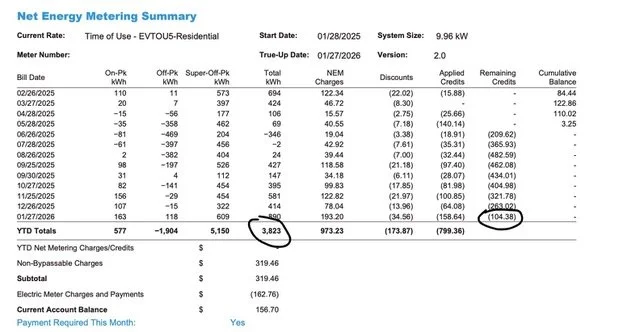
Bailey's own SDG&E net metering summary (EV-TOU-5, NEM 2.0, Jan 2025–Jan 2026). His home pulled 3,823 kWh more from the grid than it sent back, and he still finished the year with $104 in remaining credits. Credits aren't cash, though: he still paid the charges solar can't cover, $319 that year.
The bottom line
The EV rate plan used to be the best deal in San Diego for a solar owner with a car. The May 2026 change turned its greatest strength, the ultra-cheap overnight rate, into the price of your solar exports. A battery is how you get the good edge back: charge the car cheap, store the noon sun, and stop buying the most expensive power of the day.
The next step is a free Custom Battery Plan appointment. A Loft™ advisor pulls your actual usage data, checks which incentives your home qualifies for, and shows you whether the solar-plus-EV math works for your house, with no pressure either way. Or run your home through the free Loft™ battery calculator first to see your ranges.
By Loft™ Home Energy Co. — an independent home energy planning and advisory firm for San Diego homeowners. Published October 15, 2026. Last updated October 17, 2026. Rate figures from SDG&E EV-TOU-5 summer tables, August 2026, and TOU-ELEC and TOU-DR1 tables, August 2026, via the Loft™ San Diego Solar Knowledge Base; May 2026 midday change per CPUC decision D.25-09-006. Applies to SDG&E territory; SCE and PG&E differ. Nothing here is tax advice.
FAQ
Can I switch to the EV rate plan without an EV?
Only if your home is on NEM 3.0 (SDG&E's Solar Billing Plan). Otherwise, SDG&E requires an EV registered with the California DMV. Loft™ does not recommend claiming an EV you don't own, and the plan without one doesn't pencil out: the comparable battery-friendly rate, TOU-ELEC, charges an overnight price of about 34¢, not 13¢.
Do these price spreads stay this wide all year?
No. Summer is the extreme. The spreads narrow in winter, and SDG&E updates its rates periodically, so treat any specific cents-per-kWh figure as a snapshot, not a promise. The structure, cheap overnight and expensive evenings, is the durable part.
Should I just add more panels instead of a battery?
Sometimes, but adding panels can change your solar agreement with SDG&E, and more midday solar just means more power sold at 13¢. An advisor can run both scenarios against your usage data and tell you which one actually moves your bill.

By Loft™ Home Energy Co. — an independent home energy planning and advisory firm for San Diego homeowners. Published October 15, 2026. Last updated October 15, 2026. Incentive figures from the SDCP Solar Battery Savings program manual (relaunched Sept 2025); federal credit timelines from federal statute; round fill levels: Aug 2026 figure per program data, Oct 2026 pace per installer reports. Pricing ranges are Loft™'s approved gross-then-net figures. Applies to SDG&E territory; SCE and PG&E differ. Nothing here is tax advice.
