
Key takeaways
Three incentives stack: an upfront discount, the SDCP battery rebate, and a yearly performance payment.
The grid problem behind them: excess solar from 10 a.m. to 2 p.m., a supply crunch from 4 to 9 p.m. Batteries fix both.
The SDCP rebate is funded in rounds. The first round was roughly half claimed as of October 2026, and it's filling faster.
Not everyone qualifies. Your utility territory, your usage data, and funding levels all decide.
The 30% federal homeowner credit ended December 31, 2025. The upfront discount runs on a different, commercial credit that continues into the 2030s.
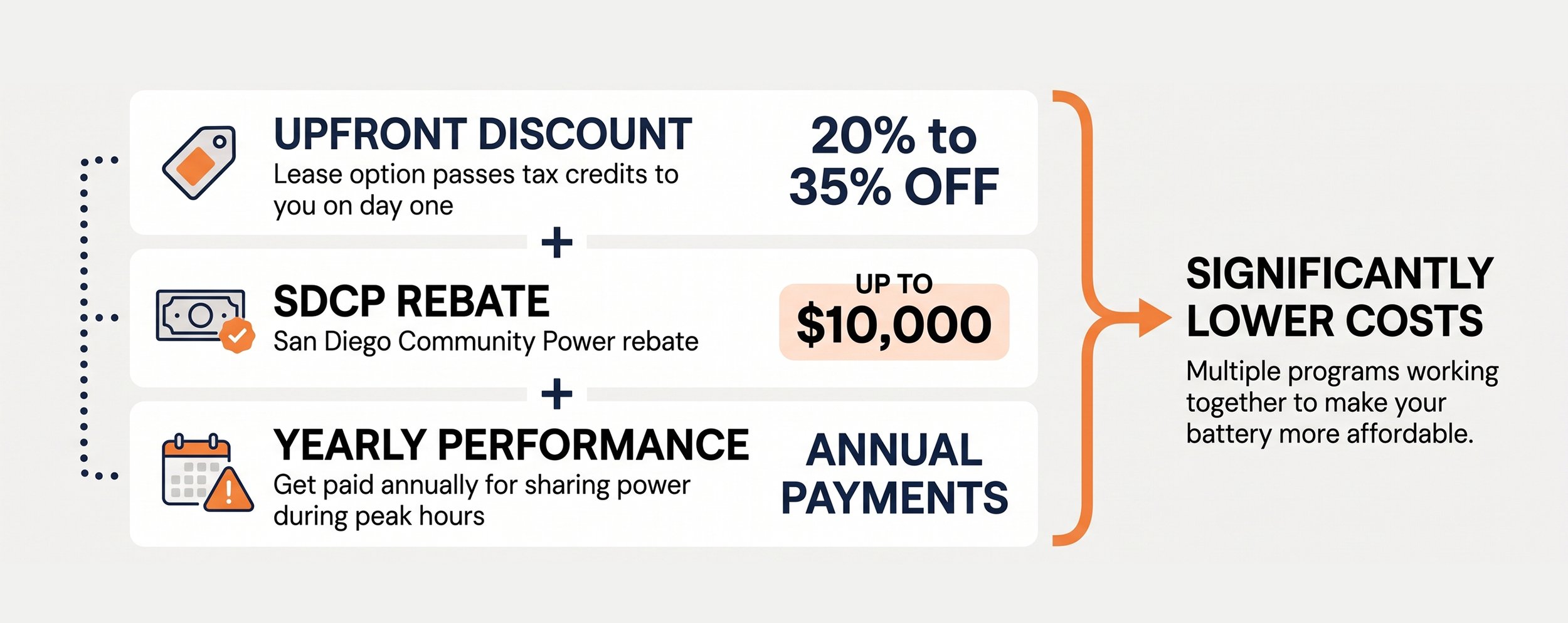
Right now, three separate incentives can cut the cost of a home battery in San Diego nearly in half: an upfront discount worth roughly 20–35%, San Diego Community Power's battery rebate of up to $10,000, and a yearly performance check of about $150–$175 per battery. They exist because the grid has a real problem — too much solar at midday, not enough at dinner — and they're all funded in limited steps, not forever.
What are the three battery incentives?
A home battery in San Diego can qualify for three distinct incentives, each from a different place and each with its own rules. They stack — a single battery can benefit from all three at once.
1. The upfront incentive. A finance partner owns the equipment for the first several years, claims a federal tax credit on it, and passes most of that value to you as a discount on day one — typically 20 to 35% below the cash price. It is not a tax credit you claim yourself, and you don't need a big tax bill to get it. After the initial term, the system can transfer to you; the exact timing depends on the contract.
2. The San Diego Community Power battery rebate. SDCP's Solar Battery Savings program pays $250 per kWh of battery added to existing solar ($350 per kWh for non-market-rate customers), up to $10,000 per project, according to the program manual. The program relaunched in September 2025 and is funded in rounds — three total. As of August 2026 it was about 29% into its first 30 MWh round; installers tracking the program say it was roughly half claimed by October 2026 and filling faster.
3. The yearly performance payment. This comes with the SDCP rebate: about $0.10 per kWh for letting your battery discharge on Community Power's weekday schedule, which works out to roughly $150 to $175 a year per Powerwall. It's a check paid to you once a year, separate from and on top of your bill savings.
Why does the grid pay you to add a battery?
Because it has a genuine problem, and your battery is the cheapest fix. From about 10 a.m. to 2 p.m., California's solar panels flood the grid with power nobody needs. From 4 to 9 p.m., when everyone comes home, the grid is desperate for supply. A home battery solves both ends: it soaks up the midday surplus and covers the evening crunch.
As Loft™ Home Energy Co. partner Bailey Maxwell puts it: SDCP isn't paying out of generosity. It's cheaper for a community power provider to subsidize batteries in customers' garages than to build or buy grid-scale storage itself. The incentive is a business decision — and that logic also tells you how long it lasts. As more homes add batteries and the midday-evening imbalance shrinks, the reason to pay you shrinks with it.
The same logic sits behind the federal piece. When the 30% homeowner credit ended for purchases after December 31, 2025, the commercial credit for leased systems survived — because Washington still wants clean-energy hardware deployed, and third-party ownership is the channel that kept working. The financier's incentive is the tax credit; yours is the day-one discount.
How long will each incentive last?
Each incentive runs on its own clock.
The upfront incentive runs on a federal tax credit for leased systems, which for batteries runs into the 2030s under current law. That's a long runway — but "current law" already changed once, when the homeowner credit ended. Treat the timeline as real but not guaranteed.
One more catch: the credit has supply-chain rules that tighten every year. A rising share of each battery's components has to come from approved (mostly non-Chinese) suppliers — 55% for systems whose construction starts in 2026, stepping up to 75% by 2030. A battery model that qualifies today may not qualify in two or three years if its supply chain doesn't keep up. Miss the rule and the credit is zero, not reduced — the credit can exist and your preferred battery can still miss it. That's one reason we confirm eligibility for the specific equipment at the time of your project.
The SDCP rebate is the one with a visible countdown. It's funded in three rounds, and round one was roughly half claimed as of October 2026, accelerating. SDCP hasn't published the dollar amounts for later rounds, so nobody can promise what round two pays. What installers see is a program filling faster than it did six months ago.
The performance payment lasts as long as you're in the program and discharging on schedule — it's the most durable of the three, but it only comes with the rebate.
Can everyone qualify?
No. Three gates decide.
Territory. The SDCP rebate is only for homes in San Diego Community Power territory — San Diego, Chula Vista, Encinitas, Imperial Beach, La Mesa, National City, unincorporated San Diego County, and (from 2028) Coronado. Homes inside Vista or San Marcos city limits are in Clean Energy Alliance territory, not SDCP, and don't qualify for SDCP's rebate. CEA runs its own, smaller program — Battery Bonus Connect, a no-cost battery for existing-solar homeowners at or below 80% of area median income, with limited funding.
Your usage data. The rebate amount and the performance payment both depend on your home's actual 15-minute usage profile — the same data SDG&E bills you on. Two identical houses can qualify for different amounts.
Funding levels. The SDCP rebate pays while its current round has money. When a round fills, the terms for the next one are SDCP's call.
The honest version: most San Diego solar homes in SDCP territory qualify for something, but the exact something is personal. That's what the usage data is for.
The incentives at a glance
Upfront incentive: roughly 20–35% below cash price on day one.
SDCP rebate: $250/kWh added to existing solar ($350/kWh non-market-rate), up to $10,000 per project (SDCP Solar Battery Savings program manual).
Performance payment: ~$0.10/kWh for weekday 4–9 p.m. discharge, about $150–$175/year per Powerwall (Loft™ KB, Oct 2026).
First funding round: 30 MWh; ~29% filled Aug 2026 (program data), roughly half by Oct 2026 (installer-reported).
What it stacks to: one battery runs about $18,000–$21,000 installed before incentives, roughly $8,000–$14,000 after them; two batteries about $29,500–$33,000 before, roughly $10,000–$19,000 after (Loft™ approved ranges, Oct 2026).
Keep, store, and control the power your home generates.
Incentives don't last forever — but they don't require rushing, either. They require knowing where you stand. Find out if you qualify — a free, no-pressure conversation about which incentives apply to your home and what your exact numbers look like. Sometimes the answer is that you're already fine.
FAQ
Is the 30% federal tax credit still available?
Not for purchases. The homeowner credit ended for systems finished after December 31, 2025. The upfront incentive is a different route — a finance partner claims the surviving commercial credit and passes most of it to you as a day-one discount.
I live in Vista (or San Marcos). Do I get the SDCP rebate?
Not if you're inside city limits — that's Clean Energy Alliance territory. CEA's Battery Bonus Connect offers a no-cost battery to existing-solar homeowners at or below 80% of area median income, but funding is limited. Your SDG&E bill names your provider; that's the fastest way to check.
Do I need to decide now?
Nobody should pressure you. The facts: the SDCP rebate is funded in rounds, round one was roughly half claimed as of October 2026, and later-round amounts are unpublished. A Custom Battery Plan appointment tells you exactly where your home lands under today's terms — that's the decision input, not a sales pitch.
Will the battery pay for itself with these incentives?
For most homes, honestly, not quickly — and we won't pretend otherwise. The incentives make the math far better than it was two years ago, but people buy batteries for control: running on their own power through the most expensive hours and keeping the lights on in an outage. The savings are a real bonus, not the reason.
What if funding runs out before I decide?
There are three rounds, and only the first is partly claimed. But SDCP sets each round's terms, and the amounts for rounds two and three aren't public. If the rebate matters to your decision, it's worth knowing where your home stands now rather than guessing later.

By Loft™ Home Energy Co. — an independent home energy planning and advisory firm for San Diego homeowners. Published October 15, 2026. Last updated October 15, 2026. Incentive figures from the SDCP Solar Battery Savings program manual (relaunched Sept 2025); federal credit timelines from federal statute; round fill levels: Aug 2026 figure per program data, Oct 2026 pace per installer reports. Pricing ranges are Loft™'s approved gross-then-net figures. Applies to SDG&E territory; SCE and PG&E differ. Nothing here is tax advice.
