
Key takeaways
A battery can be installed with no solar at all. It lives in your garage or on a wall; no roof is involved.
Since May 1, 2026, weekdays from 10 a.m. to 2 p.m. are super off-peak all year. That change hurt solar owners' credits, but a home without solar has nothing to export, so for that home it's simply a second cheap time to charge.
On SDG&E's EV-TOU-5 rate, super off-peak power costs about 13¢ per kWh in summer while 4 to 9 p.m. power costs about 80¢ (June 2026 rates). A grid-charged battery buys essentially all of its power at that lowest price.
Without an EV rate, that lowest price is about 35¢, nearly three times as much. The battery still saves money, but not enough to pay for itself. What you're really buying is outage protection, and the savings cover part of its cost.
The SDCP battery rebate prohibits grid charging, so this route gives it up. If you live outside SDCP territory, you were never eligible for it, so you lose nothing.
A grid-charged battery still keeps your home running in an outage, solar or no solar.
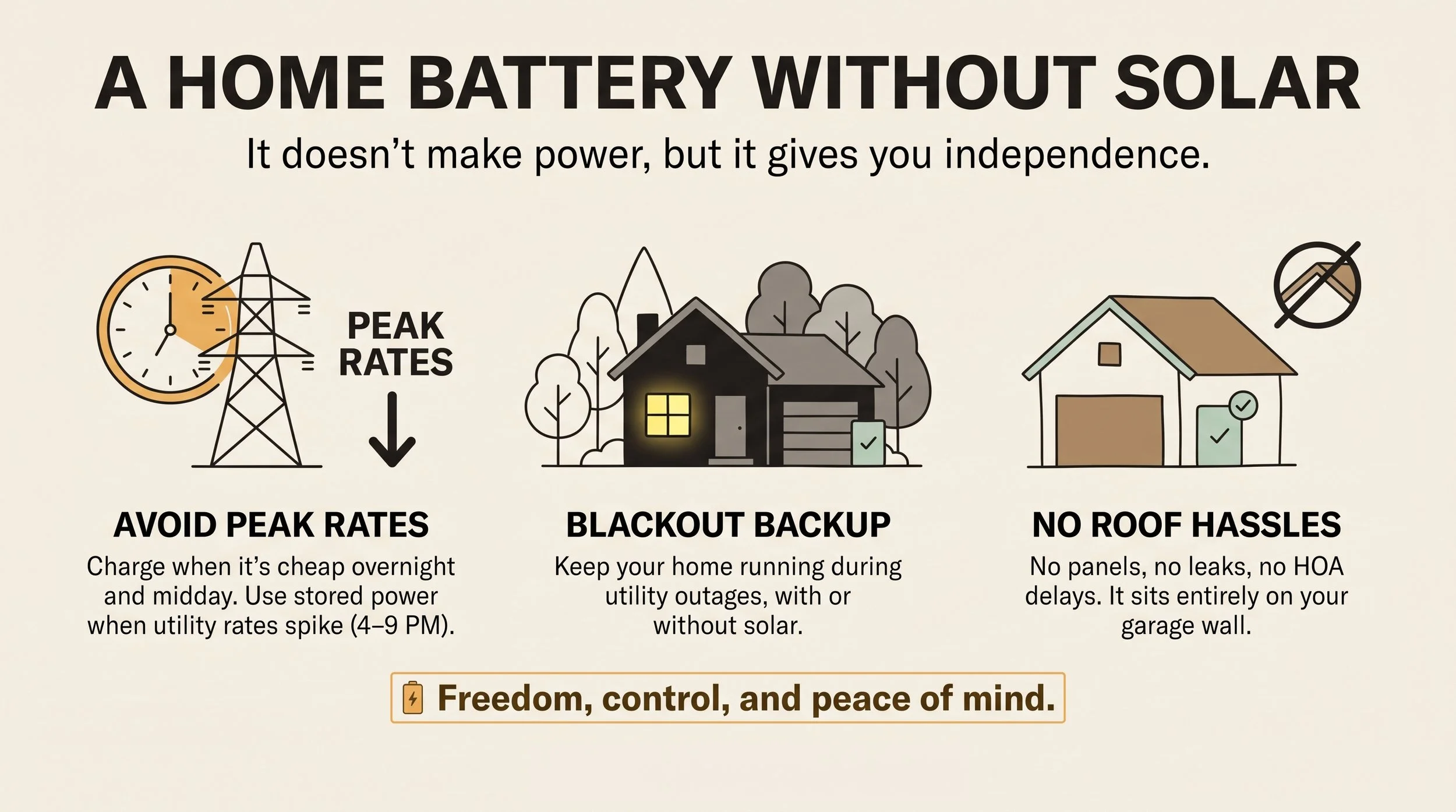
Yes. A home battery does not need solar panels. A grid-charged battery fills up when SDG&E power is cheapest (overnight, and since May 2026, weekdays from 10 a.m. to 2 p.m.), and runs your home through the most expensive hours, late afternoon and evening, instead of buying that power at peak prices. Your rate plan decides how much it saves, and the math is strongest on SDG&E's EV rate. On any plan, it keeps your home running when the grid goes down. One trade-off: a grid-charged battery can't be paired with the San Diego Community Power rebate.
Why would a home skip solar?
Plenty of San Diego homes cannot do rooftop solar, or should not. The roof is the usual reason, and none of these are fixable with a better sales pitch.
The roof is old. Panels installed today are expected to sit for 25 years. Putting them on a roof that needs replacing in five means paying to remove and reinstall them later.
The roof material fights back. Clay tile and some other materials make panel mounting expensive, fragile, or both.
The roof doesn't get enough sun. Tall trees, a neighbor's two-story house, or a mostly north-facing roof can cut production so much that panels don't make sense.
The homeowner just doesn't want panels. Aesthetics and roof penetrations are legitimate reasons. It is your roof.
There is barely a roof to use. Townhomes have small roof areas, and condo owners often don't have clear rights to the roof at all. It may belong to the HOA or be shared.
For years, the industry's answer to all of these was "no solar, no battery." That answer is out of date. The battery never needed the roof. It needs a wall, an electrical panel, and a rate plan you understand.
How does a grid-charged battery work?
A grid-charged battery is a standard home battery, the same equipment solar homes use, set to charge from the electric grid instead of from solar panels. It charges during the cheapest hours, overnight and at midday on weekdays, stores that power, and discharges it to run your home during the most expensive hours of the day.
The daily pattern is simple. Overnight, the battery fills at the super off-peak price. From 4 to 9 p.m., when SDG&E charges its highest rates, your home runs on the stored power instead of the grid. Then the cycle repeats.
The midday change works in your favor. On May 1, 2026, SDG&E made weekdays from 10 a.m. to 2 p.m. super off-peak all year, not just in March and April (CPUC Decision 25-09-006). Solar owners lost value from that change, because their midday exports now earn the lowest rate. A home without solar has nothing to export, so it only gains: a second low-price window to top off the battery just before the evening peak.
A grid-charged battery also works when the grid doesn't. During an outage, including SDG&E's wildfire safety shutoffs in the backcountry, the battery keeps your essential loads running: refrigerator, lights, medical devices, Wi-Fi. Solar was never part of that benefit. Backup comes from the battery itself.
When does the math work — and when doesn't it?
The rate plan decides how much you save. A grid-charged battery buys essentially all of its power at your plan's cheapest price, then uses it in place of the most expensive hours. So the number that matters most is that cheapest price, because it's what you pay for every kilowatt-hour the battery stores.
With an EV rate, that price is the lowest in San Diego. On EV-TOU-5 in summer, super off-peak power costs about 12.9¢ per kWh and peak power about 79.3¢ (SDG&E rate tables, June 2026). Every kilowatt-hour the battery moves from a cheap hour to evening avoids most of a 66¢ spread. That's the same math solar homes on this rate get, and few companies ever offer it to homes without solar. To get on EV-TOU-5, the EV must be registered with the California Department of Motor Vehicles. SDG&E sets the eligibility rules; we'll walk you through them, and you decide.
Without an EV, the battery still saves money, but it won't pay for itself. The rate open to battery owners without an EV is TOU-ELEC, where the cheapest power costs about 34 to 35¢, nearly three times the EV rate. Every kilowatt-hour the battery stores costs that much more, so the savings shrink accordingly. Anyone who quotes you EV-rate savings on a non-EV rate is selling you someone else's numbers.
Think of it as outage insurance. In much of the country, homeowners install grid-tied batteries for one reason: to keep the house running when the power goes out. That's the honest way to look at a battery on a non-EV rate. You're paying for protection, and the money you save by not buying peak-price power pays back part of the cost every month. Because the battery covers your 4 to 9 p.m. use, less of each future SDG&E peak-rate increase reaches your bill. SDG&E's average residential rate has roughly doubled since 2016.
Either way, one honest limit applies. A grid-charged battery still buys all its power from SDG&E. If the super off-peak price rises, your cost rises with it. Power from your own solar panels can't be repriced. That is the trade you make when the roof is off the table.
What do you give up versus solar plus a battery?
Three things, and you should hear them before anyone quotes you a price.
The SDCP rebate. San Diego Community Power's Solar Battery Savings program pays a rebate up to $10,000 per project, and its program manual states plainly that grid charging the battery is not permitted within the program. A grid-charged battery gives that up. (In practice the overlap is small: the rebate is built for solar homes.) If your home isn't served by SDCP (for example, it's in a Clean Energy Alliance city like Vista, San Marcos, Oceanside, Carlsbad or Escondido, or is served by SDG&E alone), you were never eligible, so you give up nothing here.
Selling power back. Stored grid power sent back to the grid earns nothing. A 2017 CPUC ruling excludes grid-charged storage output from net metering credit, and SDG&E caps credited battery exports at what solar panels could have produced. A grid-charged battery is for your home, not for resale.
Bundle pricing. Battery-only jobs are low-margin work for installers, so solar and battery together usually price better per unit than a battery alone. If solar ever becomes possible for your home later, the battery you buy today can charge from those panels too. Nothing about this purchase is wasted.
What does a battery-only setup cost?
One home battery runs about $18,000–$21,000 installed before incentives, and about $12,600–$14,500 after the upfront incentive. Two batteries run about $30,000–$32,000 installed, and about $19,000–$21,000 after the upfront incentive (Loft™ approved pricing ranges, October 2026). The main incentive available to a grid-charged battery is the upfront incentive, a discount of roughly 20 to 35% below the cash price built into how the system is financed. The SDCP rebate, as covered above, is not available on this route. That's why the low end here is higher than the battery prices you'll see quoted for solar homes, which usually include that rebate.
Your exact number depends on your panel, your rate plan, and your home's usage pattern, which is why Loft™ prices from your actual SDG&E usage data rather than from a brochure.
The bottom line
No solar does not mean no options. If your roof is old, tiled, shaded, tiny, or not yours to use, a grid-charged battery can still cut what you pay for evening power and keep your home running in an outage. On an EV rate, the savings are substantial. On any other plan, it's outage insurance that pays back part of its own cost.
The next step is a free Custom Battery Plan appointment. A Loft™ advisor pulls your detailed usage data from SDG&E, checks your rate plan, and tells you straight whether a battery-only setup makes sense for your home — including if the answer is that it doesn't.
FAQ
Can I add solar later if my roof situation changes?
The Tesla Powerwall 3 has a solar inverter built in, so it's ready for panels the day you add them. Many owners start with the battery for backup and rate protection and add panels when a roof replacement makes it practical.
Timing is worth thinking about. The upfront incentive comes from a federal tax credit (Section 48E), and its rules on foreign-made parts tighten every year: in 2026, at least 55% of a battery's cost has to come from non-restricted sources, rising to 75% by 2030. Nobody can say yet how that will affect which equipment qualifies, or what it costs, a few years from now. If your roof or solar plans are a few years out, one option is to get the battery now, have outage protection and today's incentive in the meantime, and add solar when you're ready. It isn't the right path for everyone. Also know that the same credit for leased solar panels is scheduled to end for systems placed in service after 2027, so panels added later may not come with the discount the battery got.
When should a battery without solar charge?
During SDG&E's super off-peak hours: midnight to 6 a.m., and since May 2026, weekdays from 10 a.m. to 2 p.m. all year. Charging at midday tops the battery off right before the 4 to 9 p.m. peak.
Does a grid-charged battery work during a power outage?
Yes. Backup power is a function of the battery, not the panels. With a backup configuration, the battery keeps essential circuits running when the grid goes down, and it refills from the grid when power returns.
Can I get the SDCP rebate with a grid-charged battery?
No. The Solar Battery Savings program manual prohibits grid charging for participating batteries. If your home qualifies for the rebate, you are almost certainly a solar home, and charging from your panels is the better deal anyway. And if you aren't an SDCP customer, the rebate was never available to you, so going grid-charged costs you nothing on this front.
I don't have an EV. Is a grid-charged battery still worth it?
Not on bill savings alone: it will save money, but less than it costs. Without an EV rate, the cheapest power you can buy is about 34 to 35¢. The case for it is outage insurance: your home keeps running when the grid doesn't, you're less exposed to future peak-rate increases, and the savings pay back part of the cost. An advisor can run your actual numbers so you can decide with your eyes open.
Can I sell the power my battery stores back to SDG&E?
No. Power you bought from the grid earns no credit when sent back. The battery's value is using cheap power yourself during expensive hours, not reselling it.

By Loft™ Home Energy Co. — an independent home energy planning and advisory firm for San Diego homeowners. Published October 20, 2026. Last updated October 20, 2026. Rate figures from SDG&E EV-TOU-5 and TOU-ELEC rate tables (June 2026) via the Loft™ San Diego Solar Knowledge Base; super off-peak hours from CPUC Decision 25-09-006; rate history from Cal Advocates (2026); grid-charging and rebate rules from the SDCP Solar Battery Savings program manual and CPUC rulings; federal credit rules from 26 U.S.C. 48E and IRS guidance; pricing ranges are Loft™'s approved gross-then-net figures. Applies to SDG&E territory; SCE and PG&E differ. Nothing here is tax advice.
