Key takeaways
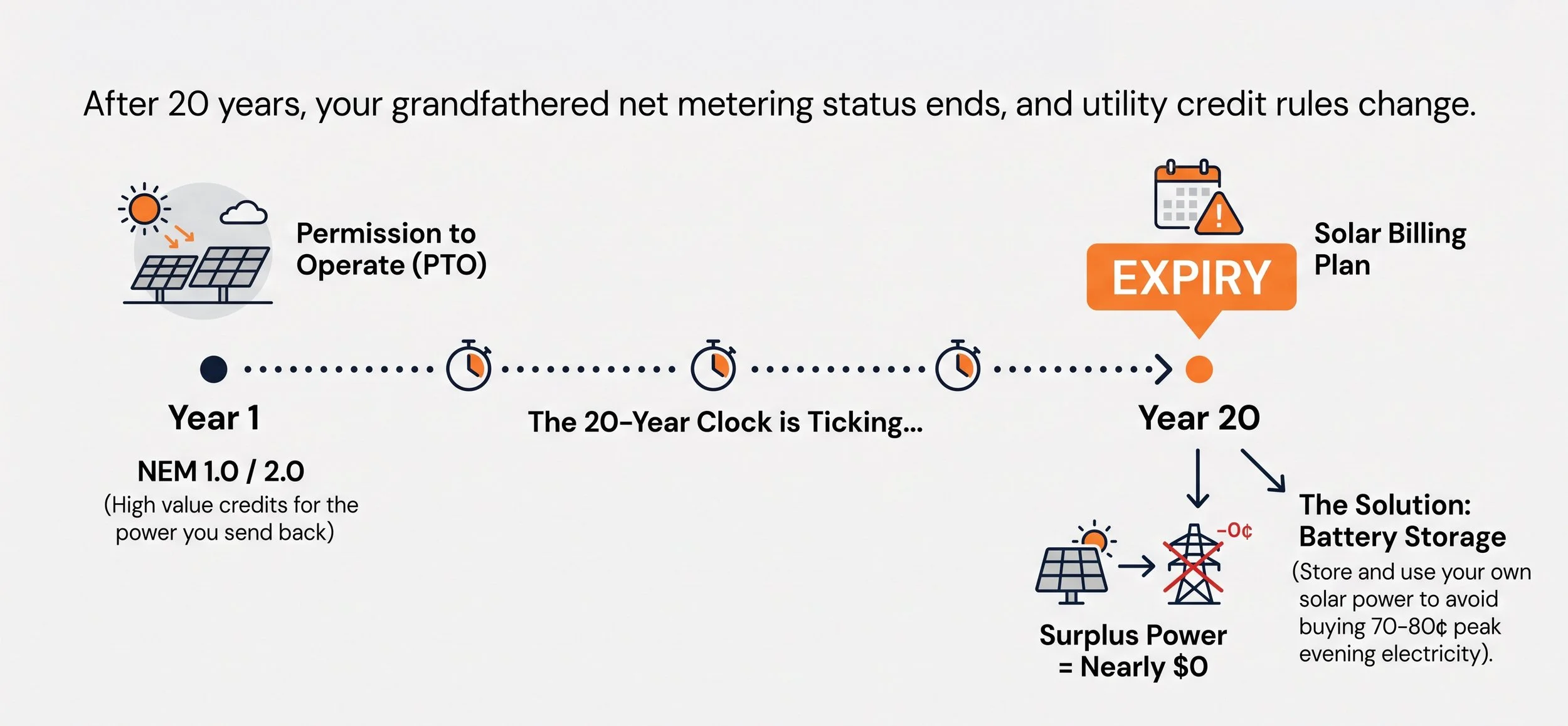
Your net metering agreement lasts 20 years from your system's connection date — then it ends, automatically.
When it ends, SDG&E moves you to the Solar Billing Plan: midday exports drop from a retail-rate credit to nearly nothing.
The clock follows the system, not the owner — and adding panels or a battery doesn't restart it.
A battery added before expiry keeps working after it: stored noon power covers the expensive evening hours either way.
Answer
Your solar agreement lasts 20 years from the day your system was connected — then SDG&E moves you to the Solar Billing Plan automatically. Midday exports drop from a full retail-rate credit to a few cents per kWh (below a cent at the worst spring hours), while dinner-time power still costs full price. Check your connection date: the clock is already running.
How do I know when my 20 years are up?
Count 20 years from the day your system was connected to the grid — permission to operate. Not the day you signed the contract, not the day the panels went on the roof: the day the utility authorized the system to run, usually within a month or two of installation. That date started a clock, and the clock is already running. Roughly:
Connected in 2006 → expires 2026 (happening now)
Connected in 2014 → expires 2034
Connected in 2016 (before June 29) → expires 2036
Connected in 2018 (NEM 2.0) → expires 2038
Two things most owners don't know. First, the clock follows the system, not the owner — if you bought a home with solar, you inherited whatever was left of the 20 years. Second, most of the systems hitting expiry now are NEM 1.0, the original net metering: the earliest SDG&E solar customers, roughly 15–20 years in.
Where's your date? Your original interconnection paperwork has it, and it shows on your SDG&E bill and in My Energy Center.
The 20 years have been challenged before. In 2025, a California bill (AB 942) tried to cut legacy contracts to 10 years — homeowner backlash got the provision stripped that July. The 20 years survived; the expiry dates didn't move.
How will SDG&E tell me it's coming?
SDG&E says you'll be notified by email and in your My Energy Center account before the transition happens. That's the official word — and it's all we can quote right now.
Here's the honest part: we haven't yet seen the exact email language SDG&E sends, so we're not going to invent it. If you've received one, forwarding it to us helps every solar owner in San Diego see what's coming, and we'll update this section with the real wording. What to watch for in the meantime: an email about your net metering agreement or "legacy period" ending, and a notice in My Energy Center. Don't wait for the email to start planning — find your date in the section above first.
What happens to my bill after the switch?
Your net metering agreement is expiring. You're losing your grandfather status. Here's what that means in dollars.
Today, the power you send to the grid earns a real credit — under NEM 1.0 or 2.0, a midday export is still worth roughly 37¢ per kWh in summer. After the switch, your exports earn the Solar Billing Plan's hourly price instead. At the worst hours — spring middays — exports can drop below a cent per kWh; most of the year they average 3–5¢. Meanwhile the power you buy when the sun goes down still costs full price, roughly 70–80¢ per kWh on summer evenings. Your solar ends up covering you only while it's sunny. Everything else, you buy back at full rates, with almost nothing to offset it.
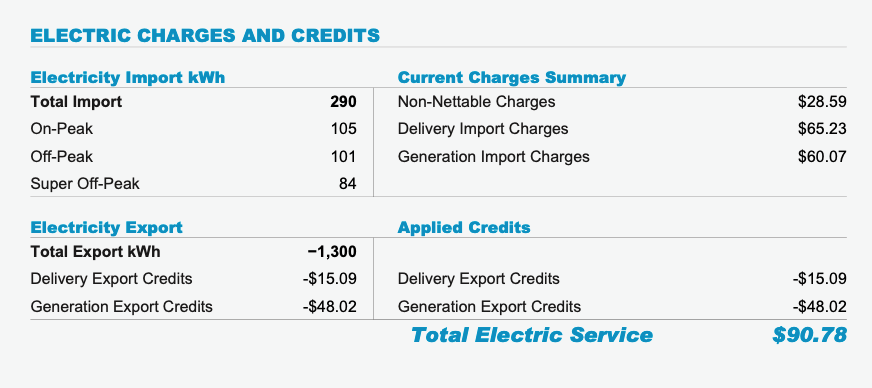
This isn't hypothetical. One homeowner's real bill tells the whole story. He pulled 290 kWh from the grid and sent back 1,300 — over four times what he used. Inside his agreement, those 1,300 kWh at roughly 35¢ would have earned about $450 in credits against about $154 in charges: roughly negative $300 — a credit, not a bill. Outside the agreement, the very same exports earned $15.09 for delivery plus $48.02 for generation: about $63 total. His bill: $90.78. Same home, same solar — a swing of about $391 a month.
One important label on that bill: it isn't a post-expiry bill. This customer lost his grandfathered status early, when a second system missed the interconnection cutoff and the account moved to Net Billing. It's the same math expiry produces — which is exactly why it's worth seeing now.
Does adding panels or a battery restart the clock?
No. Repairs, replacements, and adding a battery don't reset your 20 years — for NEM 2.0 that's confirmed in the tariff, and NEM 1.0 works the same way in practice. The clock runs from your first system's connection date, period.
Adding panels has its own rule: you can grow the system by up to 10% or 1 kW (whichever is more) and keep your agreement. Go beyond that and you choose — the new panels go on Net Billing separately, or the whole system moves over. Which brings us to a story worth hearing.
A customer added a second set of panels through the company that installed them. He was told they'd make the interconnection deadline and keep his grandfathered status. They missed it. His bill went up after adding solar — the panels that were supposed to help pushed his account onto the new rules. This is why the company you work with has to know the rules cold: the paperwork deadlines matter more than the equipment.
He's not alone. A family's story on r/solar, covered by The Cool Down, follows the same script: parents on NEM 2.0 since the early 2010s, a salesman promising a "$0 bill" with more panels, a 25-year $60,000 lease — and the original system lost its NEM 2.0 coverage. Monthly costs jumped to around $140.
What can I do before the clock runs out?
The good news: nothing about the fix requires waiting for expiry. A battery added now works under your current agreement — adding storage doesn't jeopardize your grandfathered status — and it keeps working after the switch, when the math gets worse. Stored noon power covers the expensive evening hours under either set of rules.
The wrong move is assuming you have time because the email hasn't arrived. Find your date first (see the list above). Then see your numbers: Loft™'s 15-Minute Energy Profile shows exactly how much of your power you use when it's expensive, and whether storage changes your picture before — or after — the clock runs out.
Should I wait until my agreement expires to get a battery?
You don't have to — and waiting could cost you money, even if your 20 years aren't up for a while.
Here's why. The battery rebate exists because the grid has a genuine problem: too much solar power flooding in from 10 a.m. to 2 p.m., when nobody wants it, and a huge shortfall from 4 to 9 p.m., when everyone's desperate for it. A battery soaks up the midday extra and covers the evening crunch — solving both problems at once. The rebate is the utility's cheaper alternative to buying all those batteries itself.
But that logic has a shelf life. As more homes add batteries and the problem shrinks, the reason to pay you to help solve it shrinks too. Incentives are the highest they've ever been right now — the first funding round is already nearly halfway claimed and going faster — and they won't stay that way.
Solar owners have seen this movie before. Plenty of people waited for better technology or lower prices, and watched the 30% tax credit disappear and net metering end. If your agreement is anywhere near expiring, you're one of the early adopters: you got solar when the terms were favorable, and it paid off for 20 years. Batteries are in that same window right now.
None of this means you must buy a battery today. It means that if you're going to need one eventually, it's worth looking into while the incentives are at their peak. Find out if you qualify — a free, no-pressure conversation about your timeline and your numbers.
Keep, store, and control the power your home generates.
Your agreement has an end date. Your need for power doesn't. Find out if you qualify — a free, no-pressure conversation about where your 20 years stand and what your options look like before the clock runs out. Sometimes the answer is that you're already fine.
FAQ
I'm buying a home with solar. Do I get a fresh 20 years?
No. The clock follows the system, not the owner — you inherit whatever is left of the original 20 years from when the panels were first connected. Ask the seller for the interconnection date before you buy.
Can I renew or extend my agreement?
There's no renewal. When the 20 years end, the move to the Solar Billing Plan is automatic.
Should I add a battery before or after my agreement expires?
Before is better, and not because of pressure — because the math is worse every month after the switch, and a battery works under both agreements. Either way, size it from your actual usage data, not a guess.
What if my system is only 10 years in?
Then you have time — use it. A 2016 system runs to 2036. Knowing your date now means the plan gets built on your schedule instead of the utility's.
Will I really get a warning before it happens?
SDG&E says you'll be notified by email and in My Energy Center. We're still collecting real examples of the notice — if you've gotten one, send it our way.