
Key takeaways
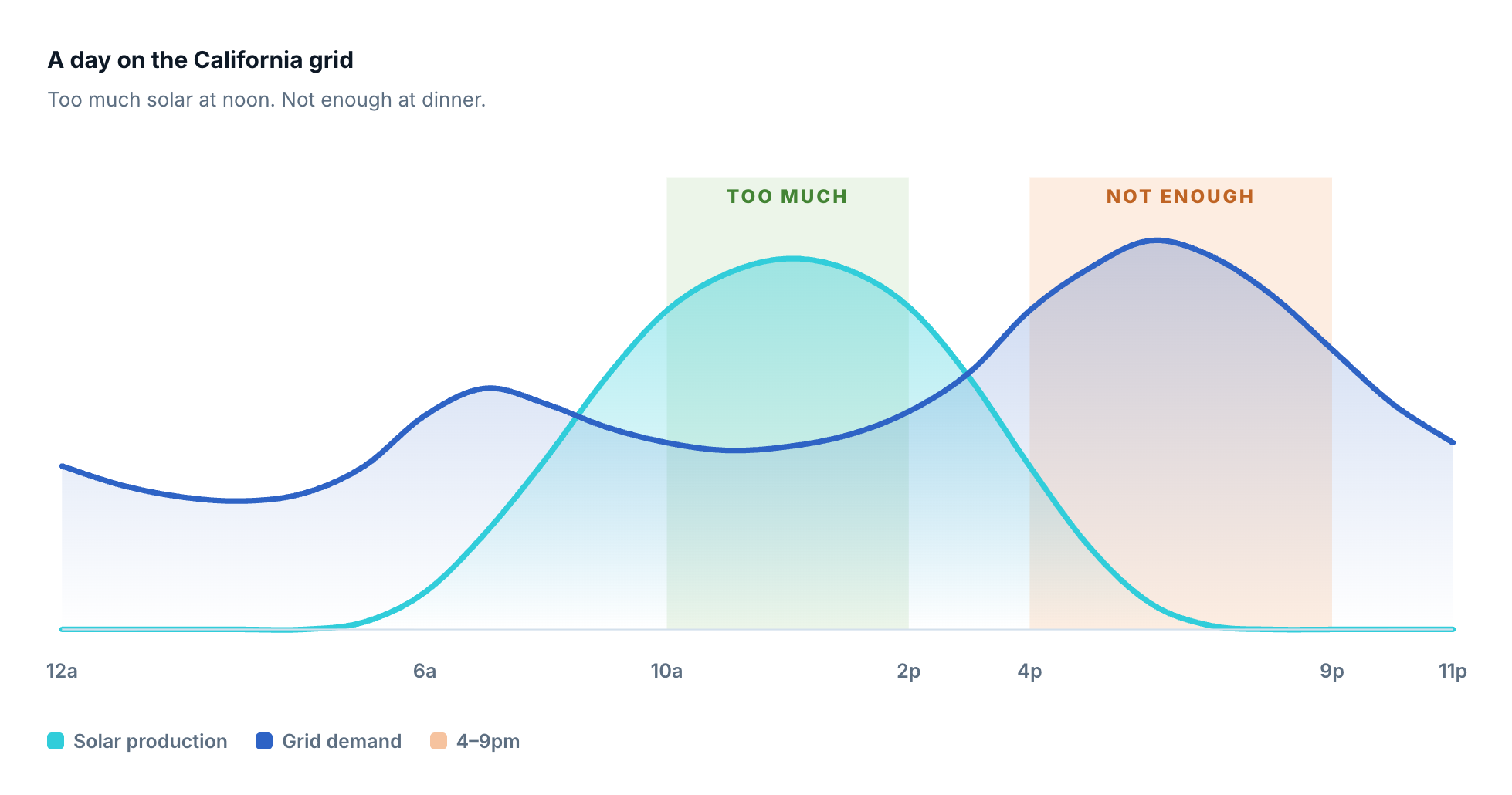
Your panels produce the most at midday — exactly when the utility pays you the least for your power.
SDG&E buys your daytime surplus cheap and sells your evening power back at its highest rates.
Your solar panels earn you the least when they produce the most. In May 2026, SDG&E cut the credit for midday solar power, while the late afternoon and evening hours — when your home uses the most power — stayed the most expensive. Your bill is climbing not because your panels stopped working, but because the rules for what your power is worth changed.
Being "grandfathered" protects your solar agreement, not your rates — rates changed anyway.
Storing midday power for the expensive hours is what moves the bill now, not adding more panels.
Answer
Your solar panels earn you the least when they produce the most. In April 2026, SDG&E cut the credit for midday solar power, while the late afternoon and evening hours — when your home uses the most power — stayed the most expensive. Your bill is climbing not because your panels stopped working, but because the rules for what your power is worth changed.
What are the rules that decide what my solar is worth?
Net metering — the rules that decide what your solar power is worth to the utility — is the short version of a long argument. The current version of those rules pays far less for the power your panels send to the grid at midday than the utility charges you for power in the late afternoon and evening.Your panels are in full sun at noon. Your house needs power most around dinner. The rules treat those two moments as completely different prices.
Why does the utility pay me less than it charges me?
Because the price of power changes through the day, and your panels and your life run on opposite schedules. From about 10 to 2, when your panels are producing the most, that's when the utility pays you the least for it. From late afternoon into the evening, when you're home cooking and cooling, the utility charges the most.
The gap is not subtle. A San Diego Tesla-app screenshot circulating in October 2026 showed the evening buy price at about $0.82 per kWh against a midday sell price near $0.06. One popular breakdown of SDG&E's summer time-of-use rates put the 4–9pm peak at 80.2¢ per kWh and overnight power at about 13¢. Same electrons. Radically different prices depending on the hour.
What changed in May 2026?
In May 2026, SDG&E cut what midday solar production is worth — the super-off-peak daytime rate became permanent and year-round, reducing the credit solar owners earn for the power they send to the grid while the sun is up. If your bills started climbing this year while your usage barely moved, this is the likeliest reason.
The pattern is showing up in real bills. One longtime solar owner posted a September annual settlement — the bill solar owners call the true-up — of $547.43 owed despite using nearly the same power as the year before (27.3 MWh used, 19.4 generated). Another homeowner's bill comparison showed the delivery portion of their SDG&E bill tripling year over year, from $13.97 to $37.03, even as generation charges fell. A Threads homeowner put it plainly: their SDG&E bill is up 400% year over year on unchanged usage.
There's a second change worth knowing about. Since late 2025, every SDG&E customer pays about $24 a month just to be connected to the grid — and no amount of solar credit can erase it, whether your system is ten years old or ten days old. On its own, that's nearly $290 a year your panels can't touch.
"I'm grandfathered — doesn't that protect me?"
Being grandfathered protects your solar agreement — the net metering terms your system was installed under. It does not protect you from the rate changes that are actually driving your bill up, and most homeowners mix the two together. Your agreement is intact. Your rates still changed. That's the part nobody explained — and adding a battery doesn't jeopardize the agreement either.
So what actually brings the bill back down?
Not more panels. More panels produce more of the same cheap midday power — the part of the day the utility already pays you almost nothing for. What changes the math is storage: keeping the power your panels make at noon and spending it during the most expensive hours of the day.
The shift is already underway. Battery storage was paired with 74% of new California residential solar installs in 2025, up from 58% a year earlier, according to Berkeley Lab data reported by pv magazine — NEM 3.0's export math is the driver. And in the same comment threads full of bill shock, the exceptions keep appearing: a Powerwall owner on r/Solar posting a negative bill with August evening export values "over $1/kWh," a Threads solar owner showing a -$116.65 credit balance. Same utility. Same rules. Different equipment.
Your power's two prices
Midday (roughly 10am–2pm) — when your panels produce the most:
What the utility pays you: about $0.06/kWh (San Diego Tesla-app screenshot, Oct 2026)
What the utility charges you: about 13¢/kWh overnight, the cheapest hours
Late afternoon & evening — when your home uses the most:
What the utility pays you: the high export credit for power you send to the grid
What the utility charges you: about $0.80–$0.82/kWh at peak (4–9pm)
FAQ
-
Usually not. More panels make more midday power — the cheapest power of the day. Your bill is driven by the expensive late-afternoon and evening hours, and panels alone can't reach those hours.
-
Your original solar agreement says which version you're on — older systems are on 20-year agreements, and anything from spring 2023 on is on the current rules. Either way, the rate changes reach everyone: what drives your bill is the mismatch between when your panels produce and when your home actually uses power.
-
No. Storage doesn't jeopardize your net metering terms — it just changes which hours your power covers.
-
Not from the bill alone. Loft™ looks at your detailed usage data — how much power you use and send to the grid, every 15 minutes — and builds a plan from that. The 15-Minute Energy Profile shows exactly where your expensive hours are.
By Loft™ Home Energy Co. — an independent home energy planning and advisory firm for San Diego solar owners. Published October 8, 2026. Last updated October 8, 2026. Sources: SDG&E afternoon briefings Oct 1–7, 2026 (Threads, Facebook, and Instagram posts as cited); pv magazine reporting Berkeley Lab data (Oct 1, 2026); The Cool Down reporting an r/Solar thread. Applies to SDG&E territory; SCE and PG&E differ.

Keep, store, and control the power your home generates.
You bought solar so you'd stop paying the utility for power you can make yourself. The rules changed, but the goal didn't have to. Find out if you qualify — a free, no-pressure conversation with someone who'll tell you straight. Sometimes the answer is that you're already fine.
