Key takeaways
San Diego homeowners buy batteries for seven reasons. Most buyers recognize themselves in two.
For homes already on NEM 1.0 or 2.0, payback is usually slow. EV households and homes on Net Billing are different. For them, a battery can pay for itself.
A battery can't erase fixed monthly charges, including the roughly $24 Base Services Charge.
If none of these reasons sounds like you, don't buy one yet.
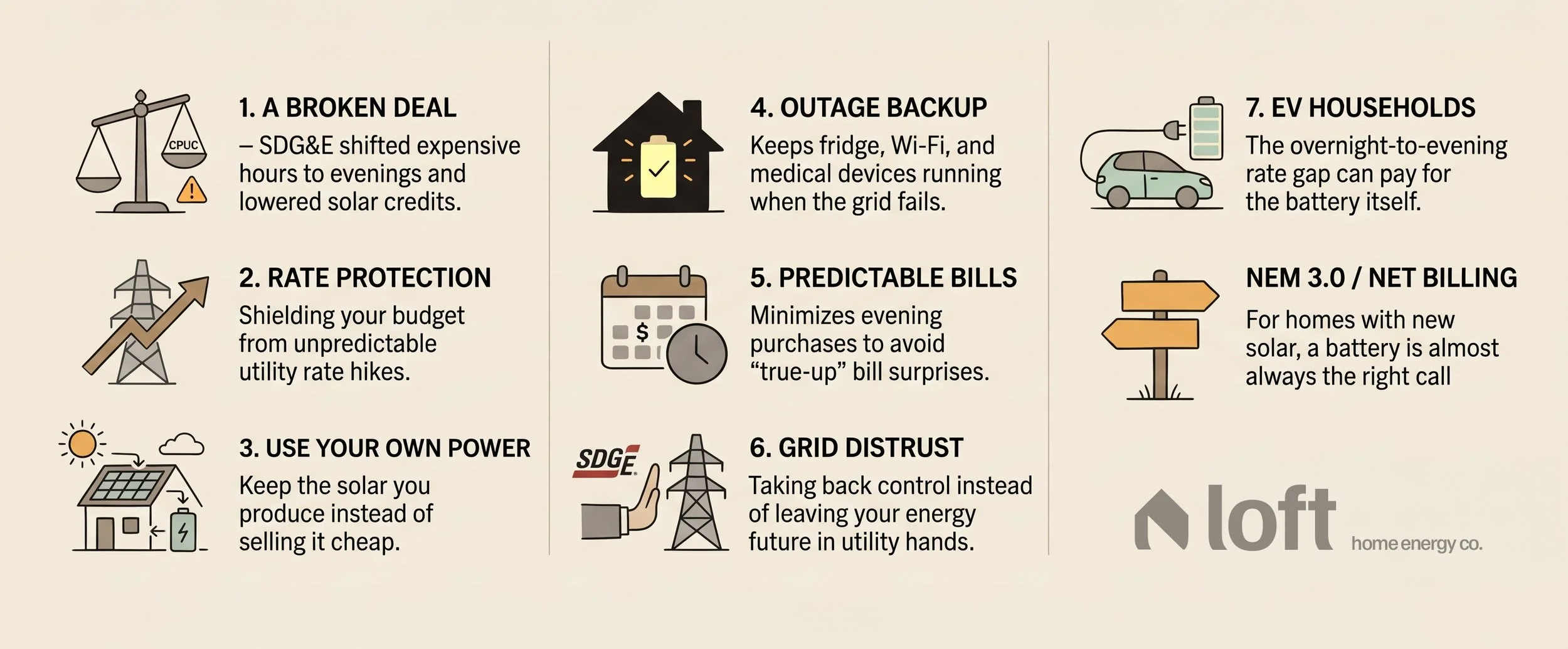
A home battery stores your midday solar for the expensive late-afternoon and evening hours. San Diego homeowners buy them for control over what SDG&E charges, a bill they can predict, and power that stays on when the grid goes down. Payback is part of the picture, but it's rarely the reason that tips the decision. Here are the seven reasons.
This article is mostly about homes that already have solar on NEM 1.0 or NEM 2.0. If your solar went in after April 2023, you're on Net Billing (often called NEM 3.0), and the answer is simpler: a battery is almost always the right call. More on that below.
What are the 7 reasons people buy batteries today?
A broken deal with SDG&E: you did everything right, then the rules changed and the deal got worse.
Distrust of the grid: you don't want your home's power decided by a utility's next rate increase.
Power in an outage: when the grid goes down, your home stays on.
A bill you can predict: fewer expensive-hour purchases, fewer true-up surprises.
Protection from the next rate change: stored power sidesteps the next rate increase.
Your panels should power your house: selling your solar cheap and buying it back at the most expensive hours offends you on principle.
The EV household: the gap between overnight and evening rates is big enough that a battery can pay for itself.
01: A broken deal with SDG&E
This is the reason we hear most. These buyers bought solar and did the responsible thing. Then the rules changed. The expensive hours moved to the evening, midday credit fell to the cheapest rate of the day, and a roughly $24 monthly charge appeared that no solar credit can touch.
Their panels didn't fail. The deal changed. What these buyers want is control back. A battery lets them keep the power their panels make at noon and use it during the most expensive hours, instead of sending it out cheap and buying it back at peak prices. If you're driven more by frustration with SDG&E than by the math, you're in this group — and you're the buyer most likely to be glad you bought.
Who it's not for: if your solar is new and your bill is already low, this grievance isn't yours, and a battery won't create one.
02: Distrust of the grid
For some buyers, the bill isn't the starting point. They don't want their home's power decided by a utility's next rate increase.
One customer put it in a sentence: "I don't trust the grid." Another, when told the savings would be modest, answered: "I know it's not going to be much [in savings]… I have other motivations for the battery."
This is the independence buyer. They want to run their home on its own power day and night, as close to off-grid as a home gets. They'd rather pay for that than leave their energy future in SDG&E's hands.
Who it's not for: if you're comfortable with the grid and comfortable with whatever SDG&E charges next, this reason will feel abstract.
03: Power in an outage
For backcountry and fire-country homes, this one needs no explanation.
SDG&E has cut power for fire safety since 2009. In December 2020 about 74,000 meters lost power, most for 35 to 48 hours. In January 2025 about 21,500 customers lost power, including 1,336 households on Medical Baseline. A solar-only home goes dark in those shutoffs too, because panels shut off with the grid by design.
A battery keeps the refrigerator, the medical device, the Wi-Fi, and the lights running, and solar refills it each day the sun shines. If someone in your home depends on powered medical equipment, or your work depends on staying online, this reason outranks all the others.
If outages are rare where you live: for most coastal homes with reliable power, backup is a smaller reason. But some homeowners buy a battery for backup alone, because they want the lights on no matter what, and they're happy with that purchase. That's a fair reason, and it's yours to make.
04: A bill you can predict
This buyer wants a bill they can predict.
The true-up is usually the trigger. One longtime solar owner posted a September true-up of $547 owed, despite using nearly the same power as the year before. Nothing changed in their home. The rates changed.
A battery makes the bill steadier: fewer expensive-hour purchases, fewer true-up surprises, a number you can roughly predict. Sometimes the surprise is the problem, not the average.
Who it's not for: if your bill is stable and you understand it, you already have predictability, and this reason adds nothing.
05: Protection from the next rate change
Rates have roughly doubled since 2016, another rate increase is pending, and the rules have changed three times in a decade. This buyer isn't betting on today's rates. They're buying out of the next change.
Whatever the peak window becomes, and whatever midday credit falls to, stored power used at home sidesteps both. That choice pays off when rates rise. In San Diego, they have, repeatedly.
Who it's not for: if you believe rates will stabilize or fall, paying to sidestep them looks expensive. That's a fair view. It's just not the one the last decade supports.
06: Your panels should power your house
The principle buyer. Selling your midday solar cheap and buying power back during the most expensive hours offends them on its face.
Their question isn't "does it pencil out?" It's "why should my solar work for the utility instead of for me?" Some also want their own clean power at night rather than grid power. There's no rebuttal to this reason because it's not a calculation. It's a preference about whose power your home runs on. A spreadsheet alone won't win this buyer over. Being listened to will.
Who it's not for: if that trade doesn't bother you, skip this one. Plenty of happy solar owners never think about it.
07: The EV household
This is the one case where Loft™ will talk about payback, because here the numbers can show it.
It comes down to the spread. On SDG&E's EV rate (EV-TOU-5), overnight and midday power is billed at the super off-peak rate, about 12¢ per kWh. Peak power from 4 to 9 pm costs about 80¢ in summer and about 52¢ in winter. (SDG&E EV-TOU-5 rates effective August 1, 2026. Rates change several times a year.)
That means solar you send to the grid at midday earns credit at the cheap rate, and power you buy in the evening costs several times more. A battery closes that gap. It stores the cheap power and covers the house through the peak. On a spread that wide, a battery can pay for itself, sometimes quickly.
Homes on Net Billing without a battery face an even wider gap, because midday exports earn only a few cents. That's where a battery pays for itself fastest.
If you're getting an EV and already have solar, the question changes from "battery or not?" to "battery, more panels, or both?" Your usage data can answer that, and it's worth its own conversation.
Which one are you?
Most buyers see themselves in two of these. That's useful information, not indecision, because the reason determines the system. An outage buyer sizes for essential loads and multi-day endurance. A control buyer sizes for the evening peak. An EV buyer plans around charging. And a buyer with no reason at all should hear that too: not everyone needs a battery, and a good advisor will say so before taking a deposit.
What does a battery actually do day to day?
Once it's installed, a battery does three things without you thinking about it. It covers the most expensive evening hours with your own solar. It keeps essential power on when the grid goes down, and solar refills it the next day. And it lets you use your own power instead of buying at whatever price SDG&E sets next. Which of those matters most depends on your reason. That's why finding your reason comes first and the price quote comes second.
But what if you only care about payback?
Then here's the honest answer, and it depends on which plan your solar is on.
For scale, a battery runs about $18,000–$21,000 installed, typically $8,000–$14,000 after incentives. What follows is whether that price also pays back, by plan.
If you're on NEM 1.0 or 2.0 and don't have an EV, a battery rarely repays itself fast on today's rates. As Loft™ partner Bailey Maxwell tells these customers: by the usual math, it rarely pays for itself fast, and it can take a really long time. The savings come from shifting your own solar into the most expensive hours, and on NEM 1.0 and 2.0 your exports still earn generous credit, so there's less to gain.
That math does have a gap. It prices your future savings at today's rates, as if rates were frozen. They've roughly doubled since 2016, and another rate increase is pending. When rates rise, every kilowatt-hour your battery moves out of the expensive hours is worth more.
It also has a limit. The battery covers part of your bill, not all of it. Fixed monthly charges, including the roughly $24 Base Services Charge, stay no matter what, and so does delivery on any grid power you still buy. If future increases land mostly on fixed charges, your savings won't grow with the bill.
And beware the chart that promises too much. Since November 2025, installers have been allowed to assume rates rising up to 10% a year in savings estimates. Pick a number like that and any battery "pays for itself." That's why this article gives you the choice instead of a chart.
If you're on Net Billing, it's a different answer. A battery is almost always the right call, and it usually pays for itself. That's why batteries were paired with 74% of new California residential solar installs in 2025, according to Berkeley Lab. New solar customers are on Net Billing, where the battery is what makes solar work.
If you have an EV, see above. The rate spread is what makes the math work.
If one of these reasons sounded like you, the next step is a free Quick Chat with a Loft™ advisor, followed by a Custom Battery Plan built from your SDG&E usage data. Bring your reason with you. It's the first thing we'll ask about.
FAQ
Is it ever about payback?
Yes, in two cases: EV households and homes on Net Billing. For NEM 1.0 and 2.0 homes without an EV, payback by the usual math is slow.
Does a battery fix my whole bill?
No. It covers the power it supplies, mainly in the expensive evening hours. Fixed monthly charges, including the roughly $24 Base Services Charge, stay no matter what, as does delivery on any grid power you still buy.
What if I recognize myself in two or three reasons?
That's typical. Tell your advisor all of them. The combination changes the sizing and setup.
What if none of these sound like me?
Then don't buy a battery yet. A home with low bills, reliable power, no EV, and no strong feelings about SDG&E is a home a battery may not serve. Revisit it if any of that changes.
I'm on NEM 1.0 or 2.0 and just want the cheapest option. Should I still buy?
Usually not, at least not now. But that answer can change: if rates keep rising, a battery bought now shields your bill from those increases, which is what could make it the cheaper option over time. The reasons above are what should move you, not a deadline — just don't assume today's math stays today's math.
Can a battery do all seven things at once?
Mostly, yes. What changes with your reason is what it should be sized and set up to do first.